Container with TS_MULTIPLIER
Sometimes, during the simulation, speed is more important than accuracy. In such case, having a bigger step size could drastically improve performance.
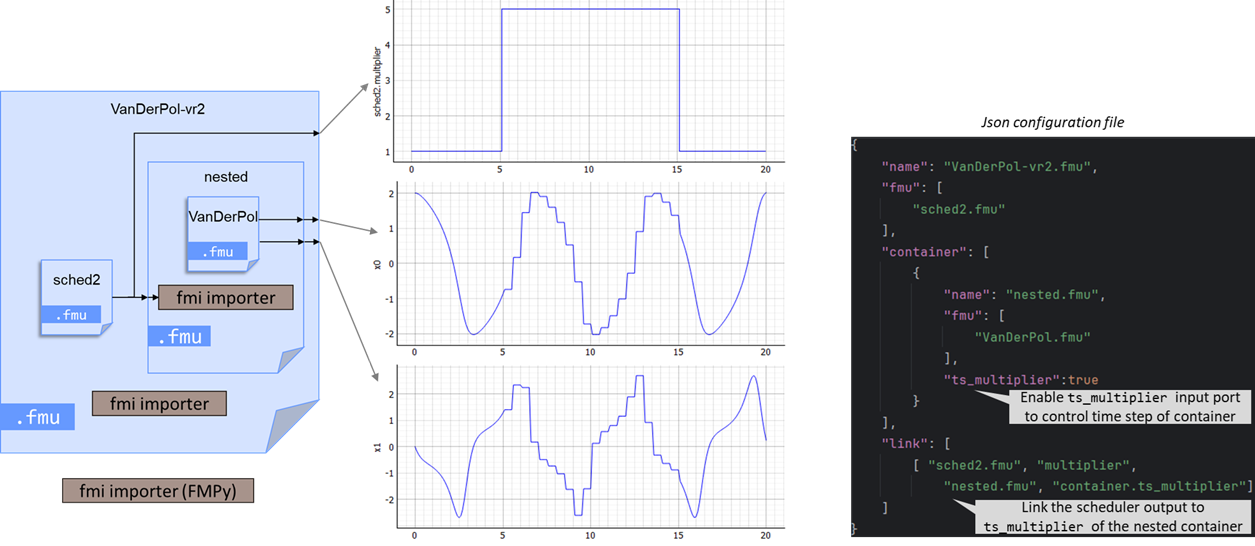
In this very simple test case, we consider two functional units represented as FMUs. 1. The first FMU, VanDerPol, generates two output signals and operates with a variable time step. 2. The second FMU, sched2, produces an integer output defined as follows:
- value 1 for 0 ≤ _t_ < 5,
- value 5 for 5 ≤ _t_ < 15,
- value 1 for 15 ≤ _t_ < 20.
The objective of this study is to use the output of sched2 to dynamically scale the sampling step of the VanDerPol FMU, whose default value is 0.1.
The same assembly can be built visually with the FMU Container Builder GUI, using the configuration node to wire sched2's output to VanDerPol's ts_multiplier input:
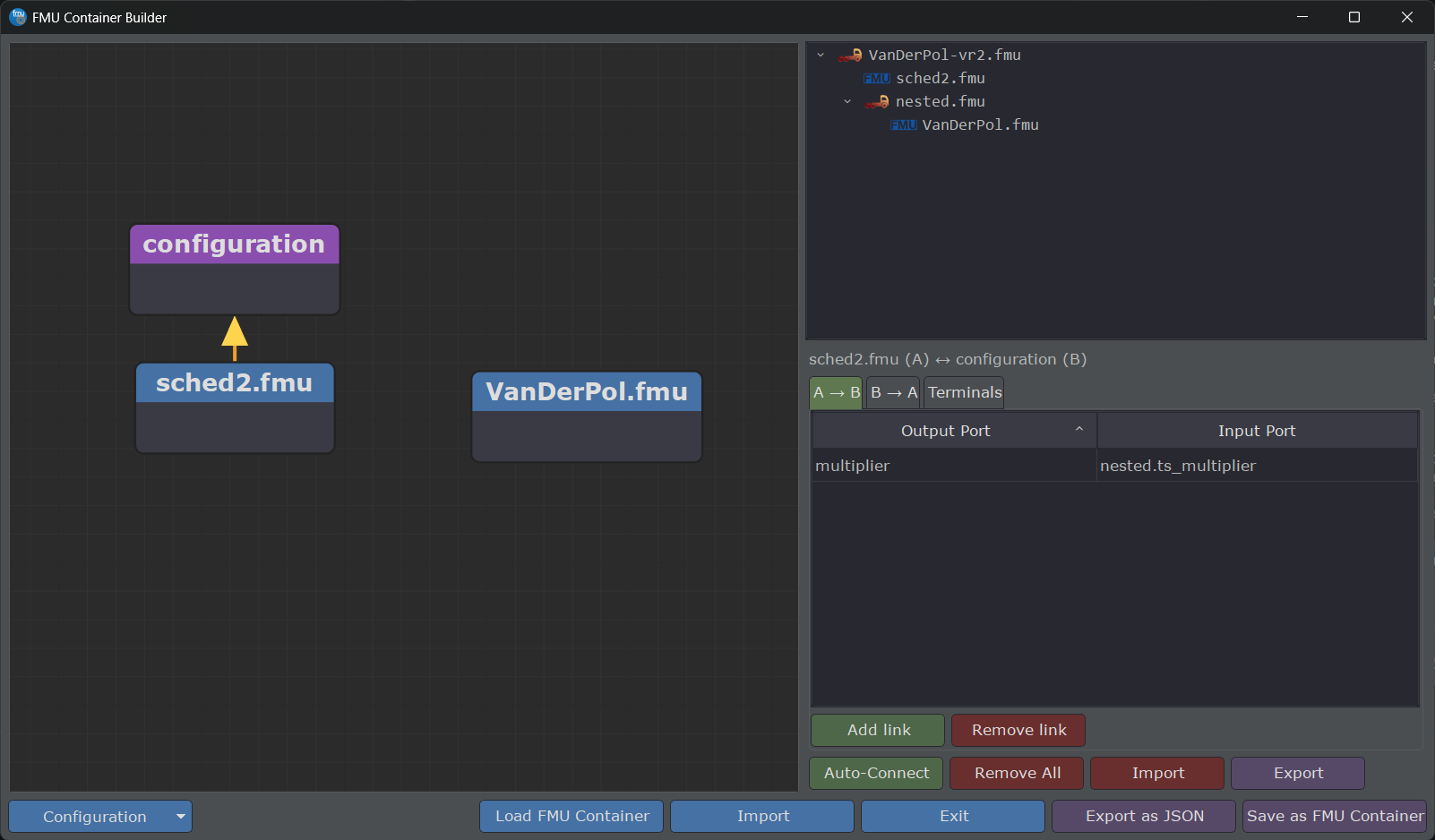
The configuration node
The configuration node automatically appears on the canvas as soon as a sub-container — here, nested (containing VanDerPol) — has its ts_multiplier parameter checked. Checking ts_multiplier on the root container would have no effect.
For illustration purposes, you can find the JSON file used to construct this co-simulation setup, along with the corresponding output figure.