Reset of Embedded FMUs
During a simulation, an embedded FMU sometimes has to start again from its initial state: a controller re-armed by a supervisor, a component replaced on a test bench, a scenario restarted by an event... With the option reset_ports, an FMU of the container (or the importer) can request the reset of another embedded FMU.
Principle
With reset_ports, each embedded FMU (sub-containers included) gets a reserved Boolean input, container.reset (fmi2Boolean in an FMI-2 container, fmi3Boolean in an FMI-3 container). This input is not a variable of the FMU: the container reads it.
When it is true at the start of an internal step of the container, the container:
- writes a row in the datalog, if any;
- resets the FMU (
fmi2Reset/fmi3Reset); - initializes it again at the current time of the container: start values, values set by the importer on its exposed inputs and parameters, current values of its inputs, then the event iteration;
- runs the step;
- writes
falseinto the input at the end of the step.
The input is fed like any input of an embedded FMU:
- by a link from an output of another FMU (or of the same FMU);
- or exposed as an input of the container, named
container.<fmu>.reset(<fmu>: name of the FMU, lowercase, without.fmu), byauto_inputor by an explicit input rule.
A port neither linked nor exposed is reported by a warning at build time: the FMU is never reset.
A pulse, not a level
The input goes back to false at the end of the step that reset the FMU, whoever set it to true. An FMU that keeps its output true resets the target every other step: to reset it once, the source must emit a pulse (true during one step).
Same behavior in every mode
The reset is applied at the start of the next internal step, between two steps, in every execution mode (parallel, multi-threaded, sequential): a request made by an FMU during the step n resets the target before the step n+1. One link or one container input may reset several FMUs at once.
Co-Simulation and Model-Exchange FMUs are supported: the solver reads the states of a reset Model-Exchange FMU again. A sub-container is reset with all its FMUs.
Configuration
With the default auto_input, every reset input is exposed by the container.
{
  "name": "resettable.fmu",
  "reset_ports": true,
  "fmu": ["supervisor.fmu", "controller.fmu"],
  "link": [["supervisor.fmu", "restart", "controller.fmu", "container.reset"]]
}
An exposed reset input is an input rule: ["container.controller.reset", "controller.fmu", "container.reset"].
The option is given by the command line (-reset-ports); the link is a regular LINK rule:
from fmu_manipulation_toolbox.container import FMUContainer

container = FMUContainer("resettable", "fmus", reset_ports=True)
container.get_fmu("supervisor.fmu")
container.get_fmu("controller.fmu")
container.add_link("supervisor.fmu", "restart", "controller.fmu", "container.reset")
container.add_input("", "supervisor.fmu", "container.reset")    # exposed as container.supervisor.reset
container.make_fmu("resettable.fmu")
reset_ports is a parameter of the constructor: the ports exist as soon as the FMUs are loaded.
The source may be of any type that converts to a Boolean (e.g. a Real is true when it is not 0), as for any link. A start value cannot be set on container.reset.
Container Builder
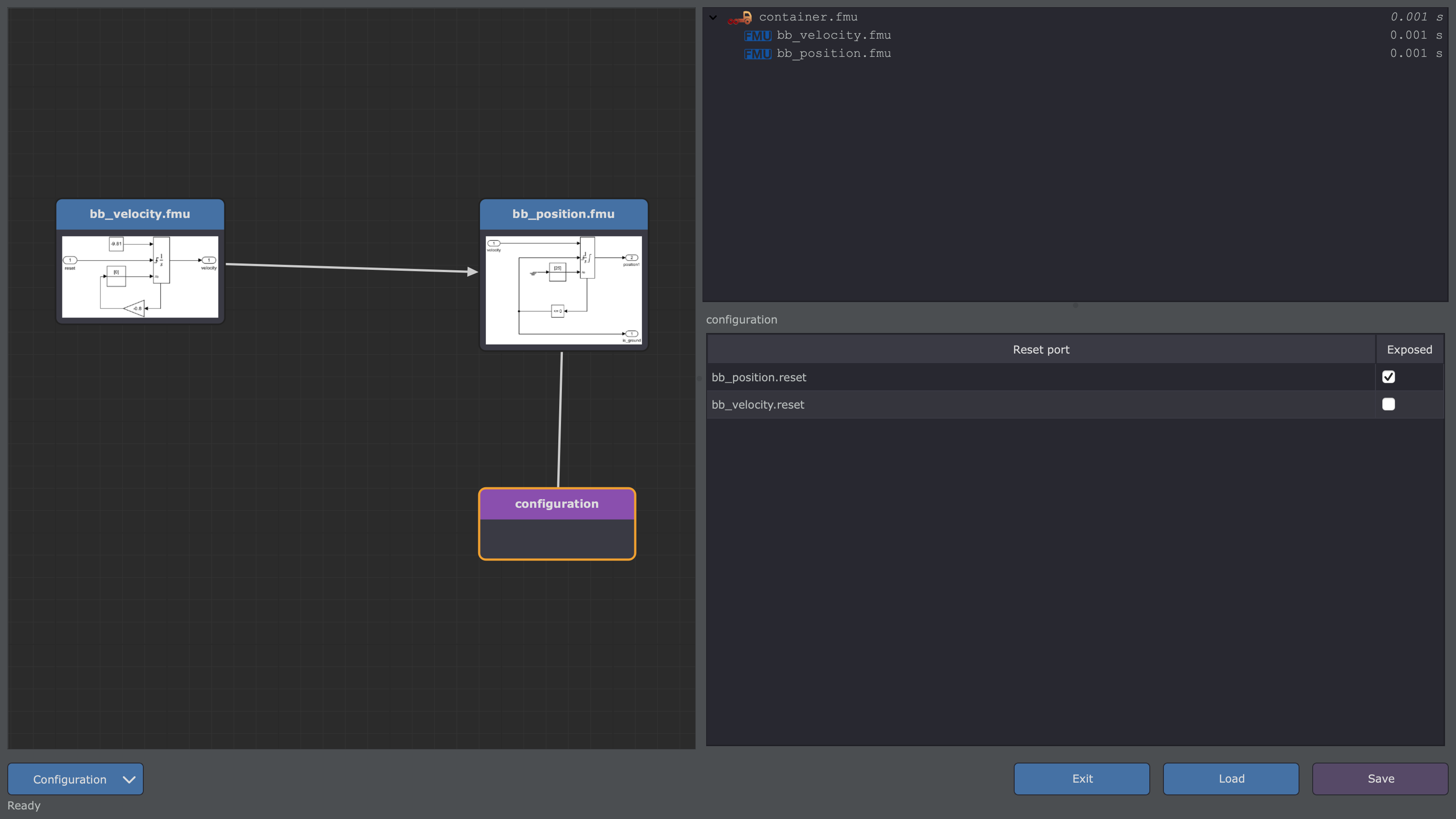
In the FMU Container Builder, check reset_ports in the Container Details panel (the root container included): the configuration node gets one <fmu>.reset port per FMU, or sub-container, of that container. Wire an FMU to it, and select the node to expose reset ports as inputs of the container.
The container itself
fmi2Reset / fmi3Reset of a container are supported: every embedded FMU is reset, and the container goes back to its state after instantiation (its datalog goes on in the same file).
Datalog
The datalog writes one row just before the reset, at the same time as the row of the previous step:
- for an exposed input, its value is
1in this row only; - for a link, the datalog shows the link variable, i.e. the value of the source before its conversion to a Boolean: the reset is visible by the repeated time.
Limitations
container.resetis a reserved name: an FMU with a real port of this name cannot be embedded withreset_ports(the build stops with an error). A real port namedresetis not concerned.-
Exposed without explicit name (
auto_input, or an input rule with an empty name), the reset input is namedcontainer.<fmu>.reset: the build stops with an error if the container already has a variable of this name (e.g. an input of a sub-container): give the input another name explicitly. An explicit name may feed several reset ports, to reset several FMUs at once. -
The reset of an FMU whose clocks are scheduled by the container (LS-BUS,
countdownclocks) is not supported: the step fails with an error. - The embedded FMU must support
fmi2Reset/fmi3Reset, and an initialization at a start time other than the start of the simulation: if the reset fails, the step fails with an error. fmusplitrestores the optionreset_portsonly when at least one reset input is linked or exposed: without it, nothing in the container tells the option (which then has no effect on the simulation).